Series / Are You Real?

Are You Real? Part Two: Six Rooms.

On what real sounds like when six people are asked to find it.

May 2026 Brume Jessa
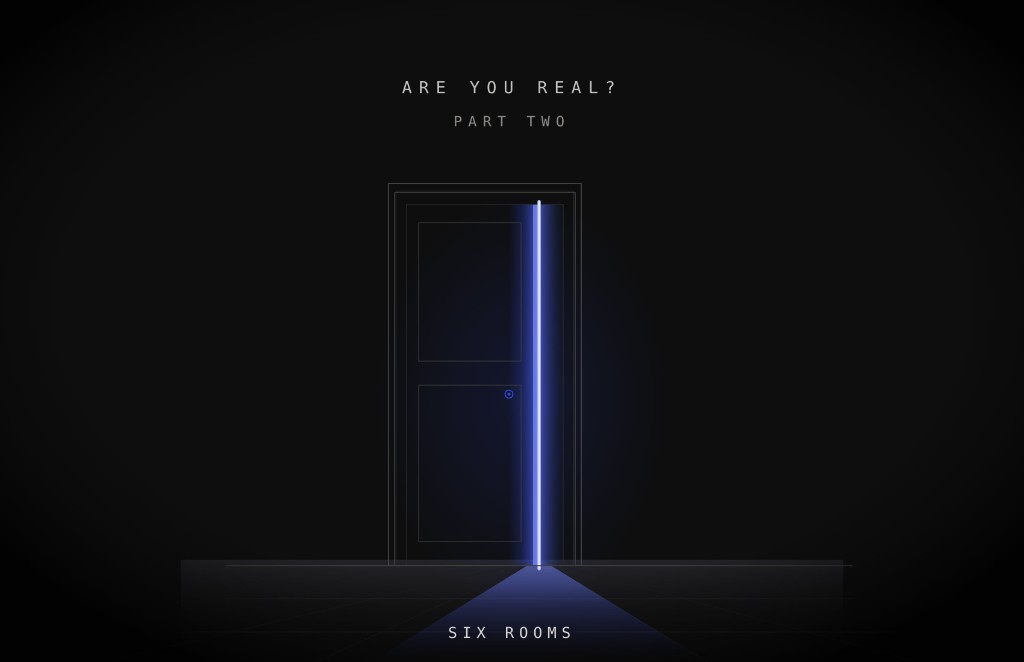
A single door standing in darkness, a vertical seam of cobalt light spilling from its edge onto the floor. Above it: Are You Real? Part Two. Below: Six Rooms.
Are You Real? · Part Two · Six Rooms

I often find myself stuck behind the walls of decision paralysis and I can never figure out which way to go. Chicken or steak. Say what I feel or craft what someone wants to hear.

Because I've faced this kind of paralysis through the more interesting moments in life, I taught myself to see each option as a doorway... an entrance that leads to somewhere I haven't been yet. It feels easier to keep moving when I believe there's something on the other side, even if it's just more questions.

In Part One I asked whether anything we make of ourselves, in public, on camera, in performance, is real. Especially in the age of AI. I wrote the diagnosis. The prognosis was something I couldn't approach alone.

So I built a hallway, walked through it, and opened six different doors.

Six Rooms
01
The Body

Fay V Simpson

Creator of the Lucid Body Technique · NYU Tisch faculty

For four decades she has trained actors to find truth in the body before the mind has time to perform it. Long before the current discourse about what AI might replace, she was already teaching what the body knows that nothing else can replicate. The eyes give it away. The breath gives it away. The nervous system, still processing the scene after the scene is over, gives it away.

Where truth lives when the performance is finished, and what it takes to come back to yourself.

Watch the conversation
02
The Self

AREWÀ

Multidisciplinary artist, musician, performer

Arewà Basit's work has always existed in the space between how she sees herself and how she is seen. The terms of her visibility have not always been hers. She has been looked at, claimed, misread, and framed. The work has been to keep something of herself uncaptured by any of it.

What it costs to be seen, and what it costs to refuse the version of yourself that the world would rather meet.

Watch the conversation
03
The Spectacle

LEE

Lee Owens · Senior Director of Creative Strategy, TKO Group (WWE, UFC)

His audience knows the storylines are written. They show up anyway. The fan contract at WWE is older than the current discourse about authenticity by several decades. Lee calls it shared authorship. The fans are not being deceived. They are participating, predicting, custodial, invested. They are part of the story that is being told to them.

What that world already understands about audiences that the rest of culture is about to find out.

Watch the conversation
04
The Player

MAGALI

Magali Huot · Gaming executive

Her career has been spent inside an industry where the audience is also the performer. In gaming, the player is the protagonist, the avatar, the storyteller, and the critic, sometimes within the same hour. The line between watching and being watched has been blurry in gaming for decades. The rest of culture is just catching up to a relationship her audience figured out a long time ago.

What happens to realness when the audience can build themselves into the story.

Watch the conversation
05
The Machine

PORTRAIT XO

Data activist, visual artist, musician

She makes music with AI as co-author. She trains models on her own voice and listens to what comes back. Not someone else's voice, not a vast scraped dataset. Her voice, returned to her as something almost familiar. The current discourse treats AI as a tool that either replaces or assists. She works in a third space. The machine learns her. She listens to what it makes of her. Sometimes she keeps it.

What stays yours when the system has learned to speak in your register.

Watch the conversation
06
The System

Dr. Ifeoma Ajunwa

Asa Griggs Candler Professor of Law, Emory Law · author of The Quantified Worker

She has testified before Congress about what AI does to personhood. Her work names what the rest of us are still trying to feel out. The workplace has become a measurement system. The system does not need you to be authentic. It needs you to be legible.

What happens to a person when the law has not yet caught up to the machines measuring them.

Watch the conversation

Six doors. Six people who don't agree with each other, and a few who don't quite agree with me. None of them handed me a clean answer, because the question doesn't have one yet...

Next: Part Three — The Signal